


 ️
️
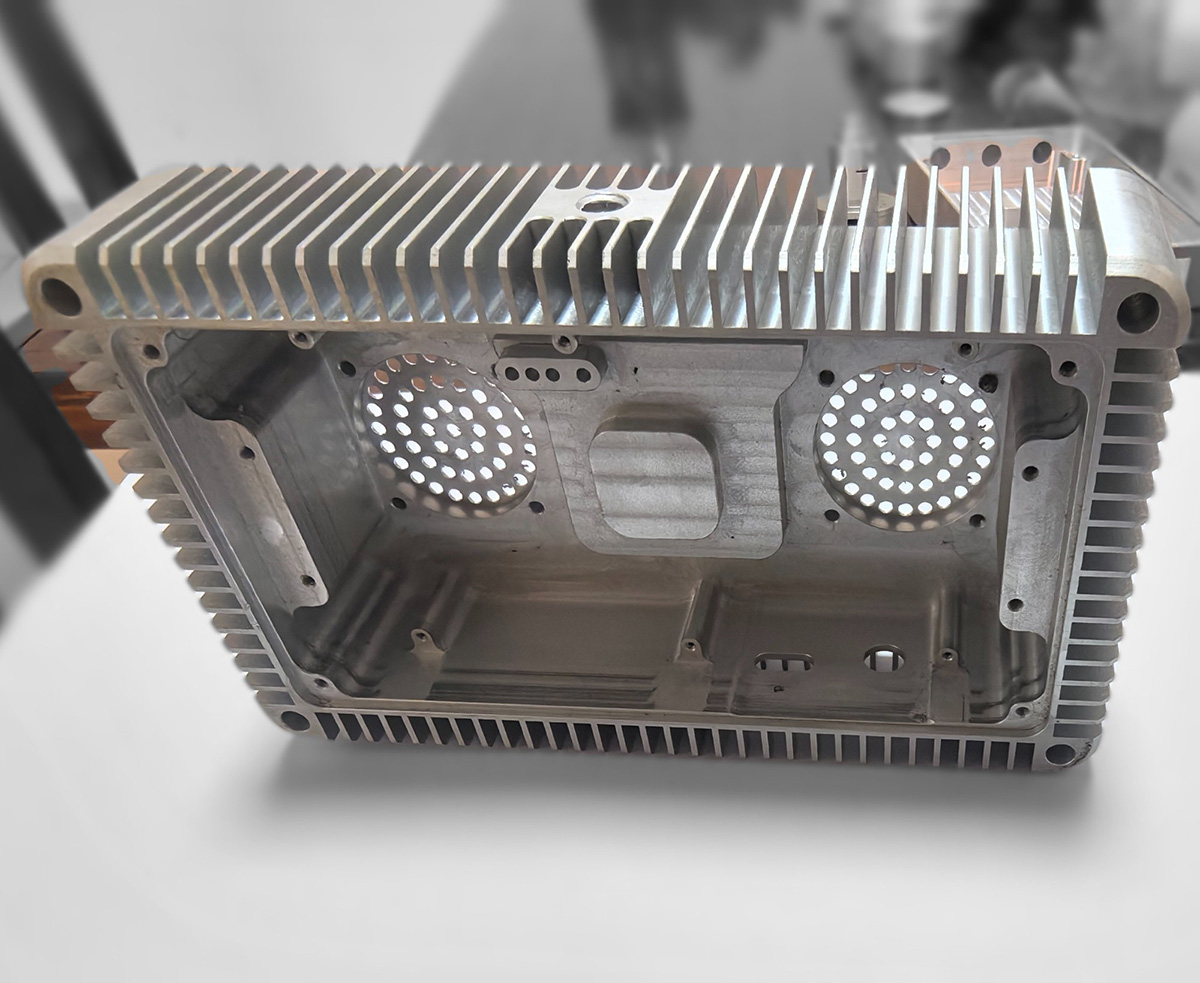
One enclosure performing thermal, shielding, sealing, and structural functions.
The enclosure houses RF circuit boards and power devices while providing heat dissipation, electromagnetic shielding, mounting interfaces, and outdoor environmental protection.
It was developed for outdoor macro and micro base stations, high-power RF amplifiers, and industrial communications gateways.
Thermal resistance, RF leakage, water ingress, and costly assembly.
The original design used a separate heat sink and equipment cavity. The joint between the two components created thermal resistance and several additional assembly and sealing interfaces.
- High operating temperature, power reduction, and summer shutdowns
- RF leakage through seams between assembled components
- Complex assembly using screws, thermal pads, and multiple parts
- Water-ingress risk at joined surfaces
- Inconsistent purchased-part tolerances during batch assembly
- Need for stable large-volume production and fast delivery
The project required a single aluminum structure that could transfer heat, contain RF energy, seal against outdoor exposure, and remain dimensionally stable during production.
Primary engineering considerationWhy the two-piece design created several linked failure modes.
The joint between the enclosure and separate heat sink interrupted the thermal path. The same seam also created additional opportunities for RF leakage and water ingress.
The long fins and thin enclosure walls introduced machining-distortion risk. Stable sealing-face flatness and hole position were therefore essential to both assembly and outdoor protection.
Thermal resistance, fin efficiency, thin-wall distortion, sealing-face flatness, hole position, RF continuity, anodized corrosion protection, and batch repeatability.
An integrated extrusion and precision-machining solution.
One-piece extruded thermal structure
The heat-dissipation fins and enclosure base were produced as one extruded section, removing the thermal break between separate components.
Thermal fin optimization
Thermal simulation was used to refine the fin structure, with the supplied record reporting an approximate 30% increase in effective heat-dissipation area.
Staged machining and floating fixturing
Rough, semi-finish, and finish machining released internal stress progressively. Floating fixtures reduced thin-wall warpage and supported a sealing-face flatness of 0.03 mm or better.
Shielding and outdoor sealing
The seamless housing, precision flange, anodized surface, gasket interface, and dust-screen mounting provision were designed to support RF shielding and an IP65 protection strategy.
From integrated extrusion to outdoor-ready enclosure.
Aluminum extrusion
Form the heat-dissipation fins and enclosure base as one continuous structure.
Staged CNC machining
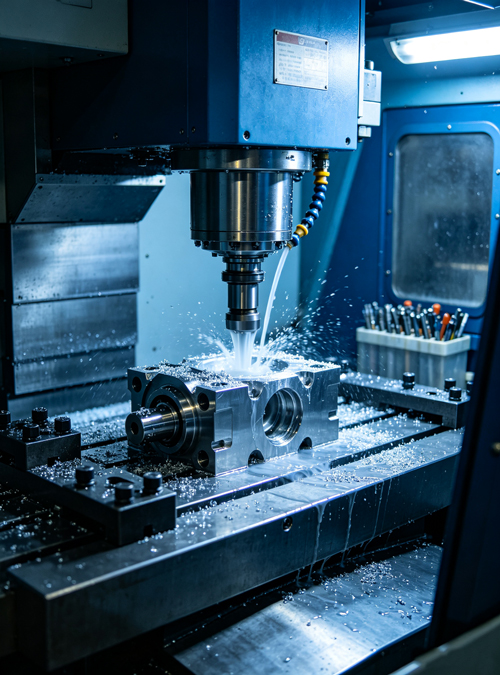
Rough, semi-finish, and finish the internal cavity, vent features, threads, and flange.
Vibratory deburring
Remove sharp edges that could damage boards, seals, or assembly components.
Natural hard anodizing
Add corrosion resistance and electrical insulation for outdoor service.
CMM dimensional inspection
Verify sealing-face flatness, hole location, and critical enclosure geometry.
Sample performance checks
Complete material, thermal, and salt-spray sampling according to the project plan.
Controls tied directly to thermal, sealing, and assembly performance.
Incoming material verification, in-process inspection, and final CMM measurement were used to maintain batch consistency. The project documentation identifies a hole-position tolerance of ±0.015 mm and a sealing-face flatness requirement of 0.03 mm or better.
Material grade, thin-wall distortion, flange flatness, hole position, thread quality, fin condition, anodized surface quality, and sampled environmental performance.
Lower operating temperature and a simpler, more reliable assembly.
The customer reported that the enclosure eliminated recurring thermal shutdown and RF-interference issues while simplifying the production line.
The one-piece design also reduced the number of purchased components and supported more consistent batch assembly.
Quantitative and certification-related outcomes are based on the supplied project documentation and should be verified against internal records before public publication.
Annual supply agreement following successful field deployment.
The supplied project record states that batch deliveries were completed on schedule with strong dimensional consistency. The customer subsequently entered an annual framework agreement and began developing additional enclosure models with Innova Forge.
Project outcome summary based on the supplied case record