

 ️
️
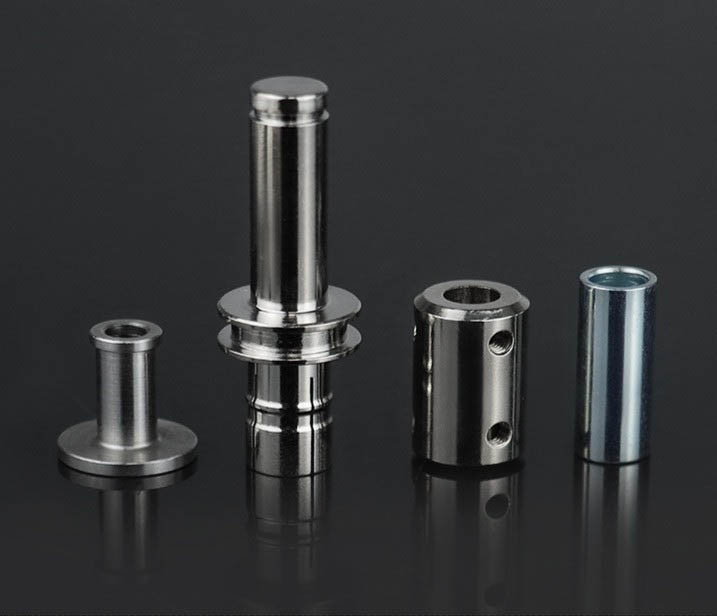
A matched moving pair for accurate control of small fluid volumes.
The valve spool and sleeve operate as a matched assembly to control the on-off state or metering of corrosive liquids. Low friction, stable clearance, and clean corrosion-resistant surfaces are essential.
Typical applications include dialysis and biochemical equipment, clean pharmaceutical valves, desalination, chemical process equipment, semiconductor fluid control, laboratory metering, and food filling.
Corrosion, sticking, unstable clearance, internal leakage, and contamination.
The previous 304 stainless parts developed pitting in chemical and seawater service. Multi-operation machining also produced coaxiality error and rough moving surfaces, causing sticking and unstable flow.
- Pitting and rust contaminating medical or process fluid
- Spool and sleeve coaxiality error causing motion resistance
- High surface friction accelerating wear and internal leakage
- Dimensional movement under temperature variation
- Insufficient passivation and salt-spray performance
- Long assembly adjustment due to inconsistent matched clearances
The functional requirement depended on the relationship between two parts: the spool and sleeve had to remain smooth, corrosion resistant, and dimensionally matched throughout service.
Primary engineering considerationWhy corrosion control and micron-level fit had to be managed together.
A corrosion-resistant alloy alone could not guarantee valve performance. Coaxiality, bore form, moving-surface roughness, and thermal dimensional stability controlled the operating friction and internal leakage.
Small radial holes and slots also required complete deburring so that seals, diaphragms, and medical fluid paths were not damaged by sharp edges or loose particles.
316L material integrity, coaxiality, cylindricity, matched clearance, mirror finish, residual stress, small-hole deburring, passivation, cleanliness, and set-to-set traceability.
A matched-component route combining Swiss turning and precision finishing.
316L material throughout
The complete spool-and-sleeve assembly used 316L stainless steel for corrosion resistance and clean-fluid compatibility.
One-setup Swiss turning
External diameters, steps, flanges, grooves, bores, radial holes, and slots were produced in one setup, supporting coaxiality of 0.002 mm or better in the supplied record.
Precision bore and OD finishing
The sleeve bore and spool outer diameter were finish-ground and polished to create a micron-controlled, low-friction fit.
Stress relief and surface protection
Low-temperature stress relief improved long-term dimensional stability. Electropolishing and passivation enhanced cleanability and corrosion resistance.
Matched-set inspection and shipment
Finished parts were measured, grouped by clearance, and shipped as matched sets for direct assembly.
From 316L bar to matched precision valve components.
316L bar preparation
Verify material and prepare stable Swiss-turning stock.
One-setup Swiss turning
Machine the spool and sleeve profiles, grooves, bores, holes, and slots.
Precision bore and OD finishing
Control cylindricity, coaxiality, and the operating clearance.
Micro-feature deburring
Remove sharp edges from radial holes and flow features.
Low-temperature stress relief
Stabilize dimensions for temperature-changing service.
Electropolishing and passivation
Produce a smooth corrosion-resistant clean surface.
Matched inspection and grouping
Measure the operating clearance and group components for direct assembly.
Inspection treated the spool and sleeve as a functional matched system.
The inspection plan covered cylindricity, coaxiality, surface roughness, small-hole condition, matched clearance, and passivated surface quality.
Coaxiality of 0.002 mm or better, matched clearance, mirror moving surfaces, burr-free holes, stress-relieved stability, corrosion-resistant finish, and paired traceability.
Improved flow stability, service life, and direct-assembly efficiency.
The customer reported smooth valve movement without sticking and more consistent micro-flow measurement.
Temperature-changing operation no longer produced the previous leakage problem, and matched-set delivery reduced production-line adjustment.
Quantitative, certification, qualification, and environmental-test outcomes are based on the supplied project documentation and should be verified against internal records before public publication.
Approved for ongoing precision valve programs.
The source states that the medical consumable scrap problem was eliminated and that the valve assembly passed the customer’s industry qualification review. The customer expanded the program to additional miniature metering-valve parts.
Project outcome summary based on the supplied case record