

 ️
️
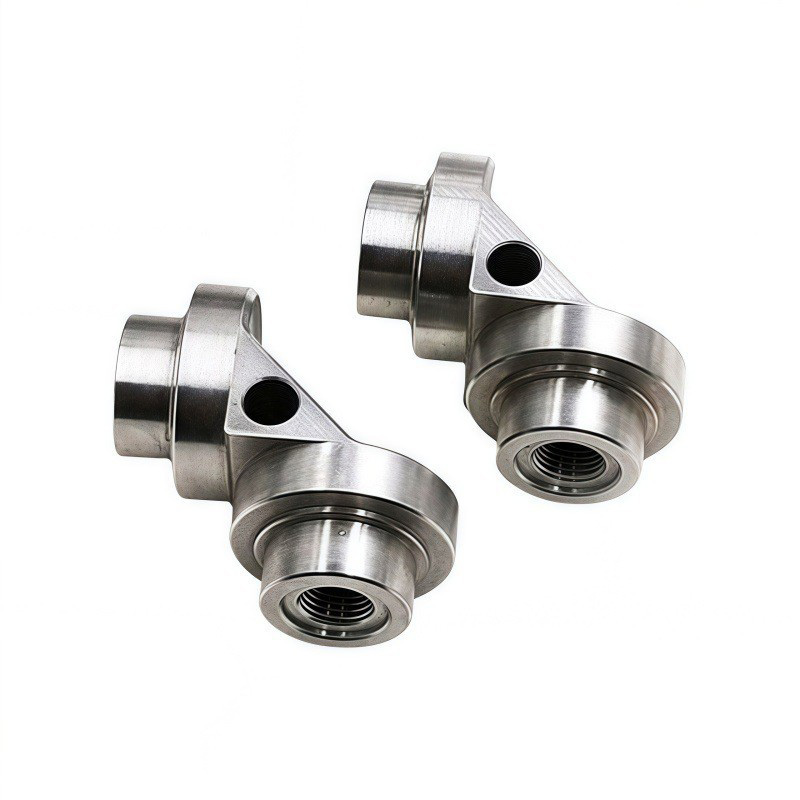
A compact fitting for directional movement in corrosive high-pressure systems.
The fitting connects fluid lines while allowing a controlled change in direction. It was developed for systems carrying seawater, chemical media, acidic or alkaline fluids, and hydraulic oil.
Applications include marine equipment, desalination, chemical processing, pharmaceutical and food equipment, environmental systems, and offshore lifting machinery.
Corrosion, angular error, internal debris, and seal damage.
The customer’s earlier carbon-steel and standard 304 fittings corroded in saltwater and chemical environments. Corrosion, internal porosity, and inaccurate angled features contributed to leakage and costly equipment stoppages.
- Rapid corrosion and perforation in marine and chemical service
- Material porosity increasing the risk of pressure leakage
- Separate turning and milling causing angular and alignment error
- Internal burrs and chips damaging seals and contaminating process media
- Unpolished surfaces difficult to clean in pharmaceutical and food environments
- Residual stress creating cracking risk during temperature cycling
The fitting had to combine accurate angled assembly, a clean internal flow path, high-pressure sealing, and long-term corrosion resistance.
Primary engineering considerationWhy material selection alone was not enough.
316L provided the required corrosion resistance, but the fitting still depended on dense forged material, accurate angular geometry, controlled sealing surfaces, and clean internal passages.
Residual stress and temperature cycling also had to be considered because an apparently sound part could develop cracking or leakage after extended offshore or chemical service.
Forging density, angular tolerance, thread accuracy, internal burr removal, sealing-surface roughness, stress relief, surface passivation, cleanliness, and pressure integrity.
A coordinated machining, heat-treatment, and surface-finishing route.
Dense forged 316L starting material
The forged blank reduced internal-void risk and provided the corrosion resistance required for seawater, salt spray, and acidic or alkaline media.
Coordinated turning and angled-feature machining
The sealing steps and internal threads were turned before the angled lugs and locating holes were machined. The supplied project specification identifies an angular tolerance of ±0.02°.
Internal passage and sealing control
Abrasive-flow deburring removed metal fragments from the complete flow path. Mirror turning achieved a sealing-surface roughness of Ra 0.4 or better.
Stress relief, electropolishing, and passivation
Solution heat treatment reduced residual stress, while electropolishing and passivation improved cleanability and corrosion resistance.
From 316L forging to pressure-tested corrosion-resistant fitting.
316L forging preparation
Use dense forged material to reduce porosity and leakage risk.
Precision CNC turning
Machine the sealing steps and 6H internal threads.
Multi-axis angled-feature machining
Machine the angled lugs and locating holes with controlled alignment.
Abrasive-flow deburring
Clear the internal flow path of burrs and stainless-steel fragments.
Mirror sealing-face finishing
Achieve the required low-roughness sealing interface.
Solution heat treatment
Relieve machining stress and support toughness under temperature cycling.
Electropolishing and passivation
Improve corrosion resistance, appearance, and cleanability.
Individual pressure testing
Complete high-pressure pneumatic or hydraulic leak testing on every part.
Inspection focused on sealing, assembly angle, and clean fluid flow.
Critical controls included 6H thread accuracy, angled-feature geometry, coaxiality, sealing-surface finish, internal cleanliness, passivated surface condition, and individual pressure integrity.
Material grade, angular tolerance of ±0.02°, thread quality, Ra 0.4 sealing surfaces, internal burr removal, surface passivation, CMM geometry, and 100% pressure testing.
Reduced corrosion-related repairs and improved assembly reliability.
The customer reported that corrosion perforation and leakage were resolved, while accurate angled geometry reduced forced alignment and thread damage during installation.
The clean internal passages also extended seal life and reduced the risk of contaminating chemical or pharmaceutical media.
Quantitative and certification-related outcomes are based on the supplied project documentation and should be verified against internal records before public publication.
Expanded into an ongoing corrosion-resistant fitting program.
The supplied case record states that the fitting was approved for continued production. The customer later expanded the collaboration to additional high-flow corrosion-resistant swivel fittings.
Project outcome summary based on the supplied case record