


 ️
️
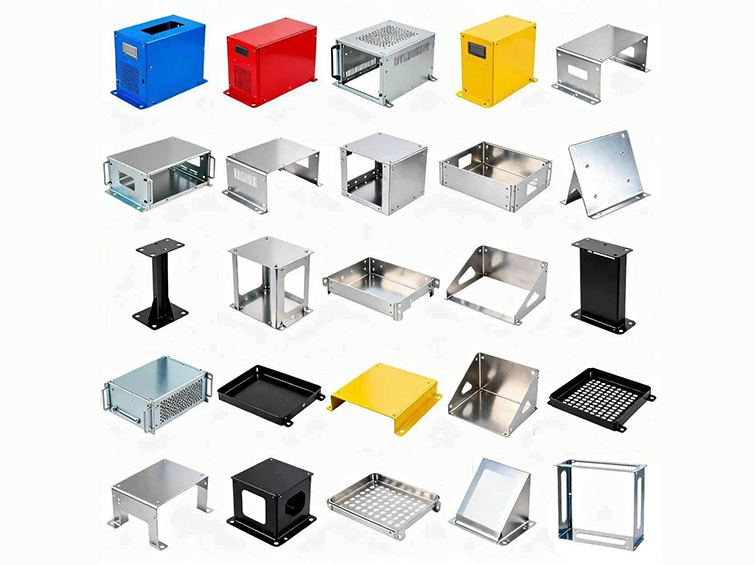
A no-tooling fabrication route for frequently changing equipment structures.
The program covered control cabinets, instrument housings, equipment brackets, cooling trays, machine bases, protective covers, and other non-standard sheet-metal structures.
Digital cutting and bending allowed the customer to revise drawings and produce prototypes or mixed small batches without the cost and delay of dedicated stamping tools.
High tooling cost, fragmented outsourcing, slow engineering changes, and assembly mismatch.
The customer managed many low-volume enclosure and bracket designs. Traditional stamping tools were uneconomical, while separate cutting, bending, welding, and coating suppliers created scheduling and quality variation.
- High mold cost for low-volume non-standard designs
- Complex ventilation patterns difficult for conventional punching
- Several outside suppliers with uncontrolled combined lead time
- Coating color variation, adhesion problems, burrs, and corrosion
- Frequent drawing changes delaying prototype validation
- Poor dimensional fit between covers, frames, and brackets
The customer needed a flexible sheet-metal system that could respond to design changes quickly and still deliver complete, accurately fitting finished assemblies.
Primary engineering considerationWhy digital cutting alone was not enough.
Laser cutting removed the need for hard tooling, but final assembly still depended on bend sequence, bend allowance, welding distortion, threaded features, coating thickness, and a controlled common datum strategy.
The production system also had to manage several materials and finishes while maintaining color and appearance across repeat orders.
Flat-pattern accuracy, material grain and thickness, nesting, cut-edge quality, bend allowance, bend sequence, weld distortion, thread position, coating thickness, color control, and assembled fit.
A complete digital sheet-metal workflow from CAD file to finished assembly.
No-tooling laser production
Drawings were unfolded and programmed directly for fiber-laser cutting, supporting one-piece orders and frequent revisions.
Nesting optimization
Professional nesting software reportedly improved sheet utilization by 15%, reducing material cost.
Controlled bending and joining
CNC bending standardized angles, while spot, full, or laser welding was selected according to structure and appearance.
Integrated secondary operations
Tapping, countersinking, riveting, deburring, and assembly were completed under the same production plan.
Standardized finishing
Carbon steel received durable powder coating, stainless parts were deburred, brushed, and passivated, and aluminum followed a lightweight heat-dissipation route.
Rapid engineering-change response
Simple prototypes could be cut in 24 hours according to the source, with drawing changes handled through program updates.
From CAD flat pattern to finished enclosure or bracket.
DFM and flat-pattern development
Review bends, relief, threads, material, finish, and assembled fit.
Nesting and fiber-laser cutting
Optimize sheet use and cut outlines, holes, and ventilation patterns.
CNC bending
Form the enclosure or bracket using controlled bend sequence and angle.
Machining, tapping, and joining
Add secondary features, welds, rivets, or assemblies.
Deburring and surface preparation
Refine edges and prepare the material for the specified finish.
Powder coating or metal finishing
Apply the selected color, brushing, polishing, passivation, or galvanizing.
Dimensional and assembly inspection
Check hole location, bends, coating, visual quality, and fit.
Inspection connected flat-pattern dimensions to final assembled fit.
The quality plan included material and thickness, laser-cut geometry, bend angles, threaded features, weld quality, surface coating, and the relationship between covers, brackets, and final equipment interfaces.
Material and thickness, cut-edge condition, hole position, bend angle, flatness, weld distortion, thread fit, coating adhesion and color, stainless passivation, and assembled alignment.
Faster prototypes and lower cost for mixed non-standard sheet-metal products.
The customer reported lower cost for mixed low-volume products, stable lead times, and accurately aligned enclosures and brackets without secondary correction.
Powder-coated and stainless products also met the required appearance and corrosion expectations.
Quantitative, certification, qualification, and environmental-test outcomes are based on the supplied project documentation and should be verified against internal records before public publication.
Annual sourcing for automation and energy sheet-metal products.
The source states that the customer established a long-term framework for the complete control-equipment and new-energy sheet-metal product family and referred additional equipment manufacturers.
Project outcome summary based on the supplied case record