


 ️
️
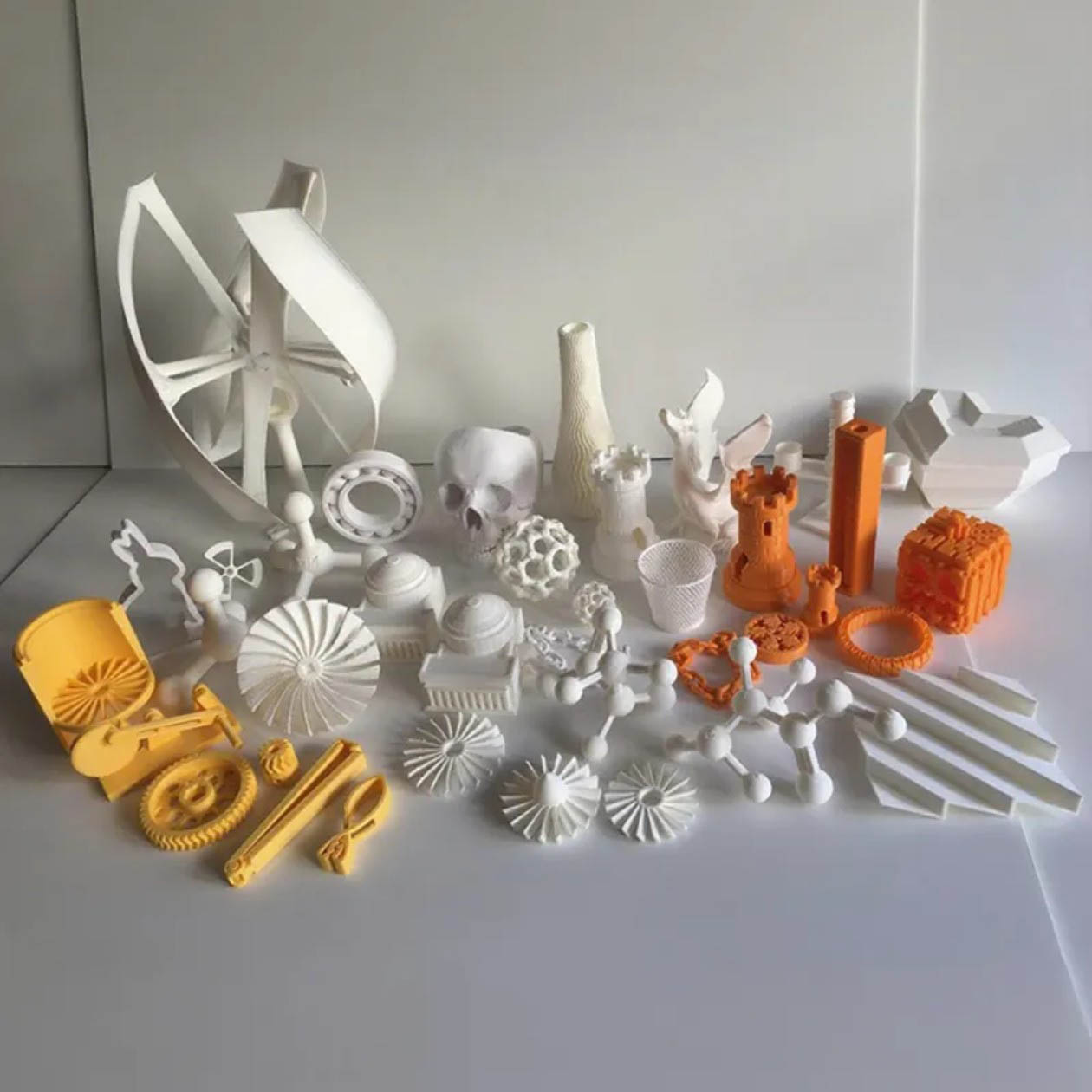
A rapid no-tooling route for complex prototypes and visual models.
The program covered industrial impellers, bearing structures, gears, lattice tests, medical housings, teaching models, architectural displays, sculptures, and decorative forms.
SLA was selected for fine detail and thin complex features, while FDM supported larger structural and lower-cost parts.
Slow conventional prototypes, impossible one-piece geometry, high one-off cost, and fragmented finishing.
Traditional CNC or mold-based prototypes required longer lead times and could not reproduce some enclosed, lattice, or deeply undercut structures as a single part.
- Seven-to-fifteen-day conventional prototype cycles
- Complex lattice, impeller, and hollow forms requiring assembly
- High cost for one-to-five-piece development quantities
- Insufficient reproduction of sculpture and fine texture
- Different vendors required for printing, repair, finishing, and display preparation
- Need for both visual and functional material options
The customer needed to validate geometry and presentation quickly, without opening tooling or redesigning complex features around conventional machining limits.
Primary engineering considerationWhy process selection depended on both geometry and prototype purpose.
A visual model required fine detail and a clean surface, while a functional test part could prioritize toughness, temperature resistance, or flexible response.
Print orientation, support placement, wall thickness, assembly allowance, and post-processing also influenced the final dimensional and cosmetic result.
Prototype purpose, SLA versus FDM selection, material behavior, unsupported geometry, support placement, wall thickness, assembly allowance, surface finishing, and display readiness.
A dual-process prototype workflow with integrated engineering and finishing.
SLA and FDM process coverage
Fine sculpture, lattice, and thin-wall parts used high-resolution resin printing, while larger mechanical structures and gears used FDM.
Complex one-piece printing
Impellers, lattices, hollow forms, and integrated educational models were produced without splitting and bonding.
Rapid scheduling
Files could be scheduled on the day of receipt, with small parts available in as little as 24 hours according to the source.
One-piece minimum ordering
The program supported single-part development without tooling investment.
File repair and post-processing
The service included file repair, support optimization, tolerance review, sanding, filling, polishing, painting, and coatings.
Material matched to function
PLA and standard resin supported visual models, ABS and engineering resin supported testing, and TPU supported flexible parts.
From digital model to finished prototype.
File review and repair
Check the model, close defects, and confirm target dimensions.
Process and material selection
Choose SLA or FDM and the appropriate visual or functional material.
Orientation and support planning
Optimize supports, build direction, wall thickness, and assembly allowance.
3D printing
Produce the one-piece prototype using the selected process.
Support removal and surface finishing
Sand, fill, polish, and repair the printed surface.
Optional color or coating
Apply paint, color, plating effect, or replication as required.
Dimensional and visual review
Confirm key features, assembly fit, and presentation quality.
Quality checks matched the prototype’s intended use.
Functional prototypes were reviewed for fit, geometry, and assembly allowance. Visual models were inspected for detail, support marks, surface finish, and readiness for display or presentation.
File integrity, feature reproduction, print orientation, support removal, wall condition, assembly fit, surface finish, color, and material suitability for the intended validation.
Faster development and lower one-off prototype cost.
Customers reported successful one-piece reproduction of structures that were difficult to manufacture conventionally.
The integrated file-repair, printing, and finishing service also reduced vendor coordination across industrial, educational, and creative projects.
Quantitative, certification, qualification, and environmental-test outcomes are based on the supplied project documentation and should be verified against internal records before public publication.
Ongoing prototype support across several customer industries.
The source describes continuing annual orders for product-development models, educational tools, and creative displays, with additional customer referrals.
Project outcome summary based on the supplied case record